Air-raid devastation
The Book ThiefAir-raid devastation is not a single isolated catastrophe but a widening state of war that moves from distant reports to sirens, shelters, ruined cities, injured bodies, and the destruction of Himmel Street. It reshapes the novel’s social world through fear and repetition while also revealing forms of collective endurance: radios carry warnings, neighbors crowd into inadequate basements, Liesel reads aloud to impose order on terror, and rescue workers confront destruction at close range. By the end, bombing has converted homes, streets, and remembered places into the material evidence of loss.
Definition and Escalation
The devastation first appears as an approaching threat rather than a fully visible event. In late March, Lübeck is bombed; Cologne is expected to be next, followed by other German cities, including Munich. The sequence makes destruction feel both geographically spreading and temporally inevitable. Relief inside the Hubermanns’ basement is therefore accompanied by instability outside it: the private world may briefly recover, but the public world is becoming increasingly unsafe.
The warning system gives this danger a mundane, almost domestic form. With money earned during the summer, Hans Hubermann brings home a secondhand radio so the family can hear the cuckoo-like warning before the sirens begin and learn which regions are at risk. They try to use the radio in the basement for Max Vandenburg, but the speakers produce only static and severed voices. Information can prepare the household, yet it cannot make the threat intelligible or guarantee safety; even the technology of warning is partial and broken.
On the night of September 19, the radio names Molching as a possible target. Himmel Street again becomes a procession of people moving toward shelter, while Hans Hubermann leaves his accordion behind and refuses to return for it when Rosa Hubermann reminds him. His explanation that the family survived the previous raid turns a practical decision into a ritual of wartime superstition. Repeated exposure blurs the boundary between logic and habit: people know the danger is real, but they also construct small rules to make it bearable.
Shelters and Collective Survival
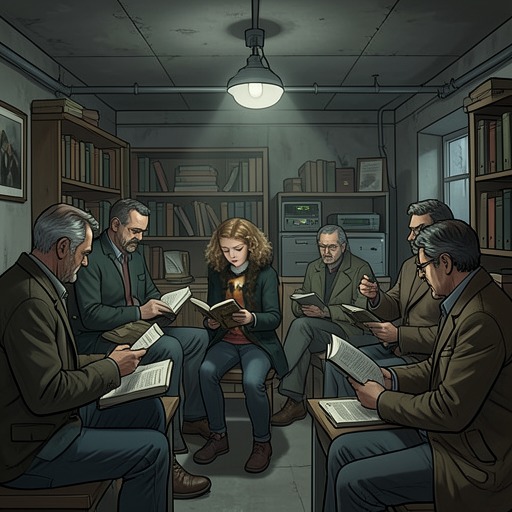
The Fiedler family lives six houses away and possesses a deep basement that becomes a communal refuge. Twenty-two people crowd into it, including the Steiner family, Frau Holtzapfel, Pfiffikus, a young man, and the Jenson family. The shelter is not an abstract symbol of safety. One bare globe hangs from the ceiling; the room is dank and cold; jagged walls press into people’s backs; and distorted sirens leak through the structure. The group listens for the three signals that will announce the raid’s end, because those sounds provide the limited certainty available to civilians trapped underground.
The shelter also reveals how disaster reorganizes social relations. Rosa Hubermann and Frau Holtzapfel are kept apart in the interest of a civil atmosphere, although the scale of the danger makes their ordinary quarrels seem petty. Rudy Steiner finds Liesel among the crowded bodies, and the presence of children, families, and neighbors turns the basement into both a place of apprehension and a temporary community. The shelter cannot prevent fear, but it gathers people into a shared condition rather than leaving each household to face the raid alone.
During one raid, Liesel opens The Whistler and begins reading aloud because the noise is too overwhelming to endure directly. At first her words are lost beneath the din, and Mama’s demand that she repeat herself does not interrupt her concentration. Rudy notices what she is doing, tells his siblings to listen, and Hans Hubermann moves closer. By the third page, the crowded basement has become quiet except for Liesel’s voice. Reading does not stop the bombing, but it changes the social atmosphere inside the shelter: fear becomes attentive silence, and language supplies a temporary structure where the outside world offers only alarms and impact.
Cities, Bodies, and Wartime Labor
Air-raid devastation is also encountered through the work required after bombs fall. In late November, Hans Hubermann experiences his first actual raid while serving with the LSE in Stuttgart and later Essen. The truck is surrounded by rubble, smoke, fire, shouting, and collapsing frameworks; ruined buildings are piled into mounds, while smoke bombs stand in the ground like matchsticks and fill the city’s lungs. Hans works in a line with Sergeant Boris Schipper, Kessler, and Brunnenweg, directing water through the smoke so that each man sprays the fire and, in the confusion, Hans sprays the others as well. The scene makes rescue labor appear both necessary and nearly absurdly difficult: order survives only as a precarious chain of bodies working inside obscurity.
The physical cost of this wartime machinery becomes explicit when an olive-green truck overturns on its way toward a camp. A punctured left front wheel sends the vehicle rolling repeatedly, throwing men, air, light, rubbish, and tobacco together until they are crowded against one wall. The aftermath is recorded in blunt bodily terms: six men are burned by cigarettes and two have broken hands. Such injuries extend air-raid devastation beyond the moment of the explosion. Transport, military duty, and emergency labor continue to produce damage even when the immediate danger is not visible.
The novel places these injuries beside other wartime bodies damaged by cold, hunger, and violence. Max Vandenburg spends long periods on cool cement, where minutes become cruel and hours punishing. Later, his health declines through constant coldness, swimming hands, failing exercise, weight loss, and a face pressed against the basement floor. These details show that sheltering is not equivalent to safety: confinement protects him from one form of persecution while exposing him to a slow physical deterioration. The bodies of the starving Jews forced down Munich Street, with enormous eyes, dirt molded to them, staggering legs, and soldiers’ hands driving them onward, make the same point on a larger scale. War distributes suffering through bombs, imprisonment, forced movement, exposure, and deprivation.
Destruction and the End of Himmel Street
The most consequential bombing arrives as the destruction of Himmel Street. The narrative imagines the street at night, with wet air and pressure changing before the first bomb strikes Tommy Müller’s apartment block. Tommy and his sister Kristina are asleep, their domestic details remaining visible for a moment before the attack consumes them; their mother lies nearby, and the roofless ceiling turns hot plate red above the household. The attack then spreads through the poorer part of town, and within a few minutes almost everyone is gone.
The destruction is rendered through the disappearance of familiar structures. A church is chopped down, and the earth is destroyed where Max Vandenburg once stood. At 31 Himmel Street, Frau Holtzapfel appears to be waiting in her kitchen beside a broken cup, a final arrangement of ordinary objects within a world that has already ceased to protect its inhabitants. The devastation therefore erases more than buildings. It removes the physical coordinates of relationships, routines, arguments, lessons, and acts of care, leaving survivors to reconstruct a neighborhood through memory.
The ending also makes the bombing a crisis of narration. The black book is disintegrating under the weight of the narrator’s travels, and the account of Himmel Street becomes a way to preserve what physical destruction has made vulnerable to disappearance. The narrator moves from street to street and returns for a single man, while the ruined landscape becomes inseparable from the story of the people who occupied it. Air-raid devastation thus produces a double aftermath: material obliteration in the world and an urgent attempt to keep the lost world present through words.
Narrative and Thematic Significance
The novel repeatedly interrupts scenes of domestic life with the language of warning, rubble, smoke, and bodily injury. This structure prevents bombing from becoming a single spectacular climax; instead, devastation accumulates through alerts, preparations, shelter routines, damaged transport, exhausted workers, and delayed recognition of loss. The repeated movement from street to basement and back again records both social resilience and the limits of resilience. Neighbors can share space, information, attention, and reading, but no communal practice can finally withstand the bombs that strike Himmel Street.
The contrast between collective care and indiscriminate destruction gives air-raid devastation its deepest significance. In the Fiedlers’ basement, twenty-two people survive fear together, and Liesel’s reading briefly makes a crowd into a listening community. Hans Hubermann’s labor turns him toward the ruins of other cities, while Max’s confinement and the prisoners’ forced march reveal forms of destruction that proceed through exhaustion and human policy as much as through explosives. When Himmel Street is finally erased, the catastrophe exposes the fragility of every shelter and simultaneously explains why acts of attention, memory, and storytelling matter: they cannot save the buildings, but they can resist the second destruction in which the dead and their world are forgotten.